

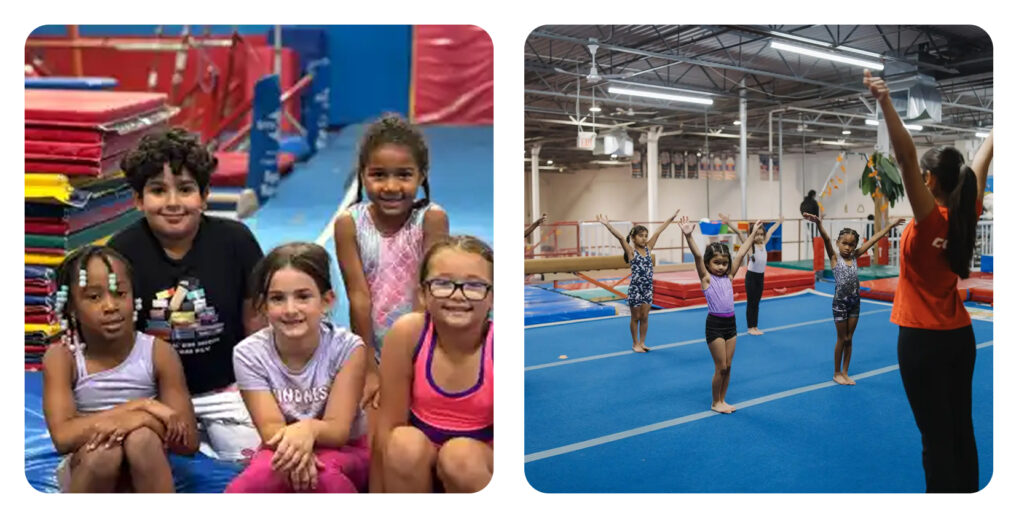
If you’ve ever watched a toddler bounce off the couch, scale the bookshelf, and try to “fly” off the stairs in the same afternoon, you already know they need somewhere safe to do all of it. That’s exactly what a preschool gymnastics class offers. As the preschool program coach at All Star Sports Centre in Brampton, I get asked the same question every week by new parents: what do toddlers actually learn in gymnastics? The honest answer is far more than tumbling.
Gymnastics Under 5: Play With a Purpose
To a parent watching from the mezzanine, a preschool gymnastics class can look a bit like organized chaos. Kids are rolling, climbing, hanging, jumping, giggling. But every minute of that “play” is designed.
This is what early movement education looks like in practice. Coaches deliberately layer in activities that build gross motor skills for toddlers running, jumping, balancing, hanging, landing while disguising the work as fun.
The science backs this up. The Canadian Society for Exercise Physiology (CSEP), through its 24-Hour Movement Guidelines for the Early Years, recommends that toddlers and preschoolers get at least 180 minutes of physical activity daily, spread throughout the day. A weekly gymnastics class doesn’t replace that but it builds the body confidence kids need to choose movement on their own time.
Gymnastics Canada and Sport for Life both identify ages 1–5 as the most critical window for physical literacy. Skills built now stay for life.
What Toddlers Learn, Age by Age
What a child learns depends entirely on their stage. A 14-month-old in their first parent-and-tot class is doing very different work than a confident 4-year-old. At All Star Sports Centre in Brampton, the preschool gymnastics curriculum is built around three age bands, each with its own developmental goals.
10 Months–2 Years (Parent & Tot)
This is where it all starts. In our parent and tot gymnastics classes, caregivers participate alongside their child to provide safety, encouragement, and physical guidance. The session focuses on sensory play, soft obstacle courses, and gentle apparatus exposure.
In a typical session, the youngest gymnasts work on:
- Crawling, climbing, and rolling over soft inclines
- Hanging from low bars with caregiver support
- Walking along low foam beams
- Bouncing on the trampoline in a seated or standing position
- Simple “follow the leader” listening games
For a closer look at this age, read our companion guide on baby gymnastics from 10 months.
Ages 2–3
At this stage, children separate from caregivers for the first time and join short, structured classes. Independence becomes the goal both physically and socially. The toddler gymnastics class structure stays playful but introduces predictable routines: warm-up, station rotation, free play, cool-down.
Two-year-olds typically work on:
- Forward rolls down a soft wedge
- Two-foot jumps off low surfaces
- Walking the full length of a low beam unassisted
- Hanging on bars for 5+ seconds
- Stopping when they hear the word “freeze”
Curious how this age handles the transition? Our deep-dive on gymnastics for 2-year-olds walks through what to expect in the first month.
Ages 4–5
By four, kids are ready for a structured preschool gymnastics curriculum that mirrors the recreational program just shorter and more game-based. Skills become deliberate, and coaches start using gymnastics-specific vocabulary like “tuck,” “straddle,” and “pike.”
Four- and five-year-olds practise:
- Independent forward rolls and roll-to-stand
- Cartwheel progressions over a line
- Pullovers and chin-hangs on bars
- Walking on a regulation beam with assistance
- Multi-step routines they perform in sequence
This is when you’ll start to see kindergarten readiness activities show up in obvious ways lining up, taking turns at stations, responding to their name.
The Hidden Curriculum: Listening, Sharing, Confidence
Here’s the part of the program most parents don’t expect. Half of what your child learns in a preschool gymnastics class has nothing to do with somersaults.
Coaches embed social rules into physical play. A child who would never sit still for a “listening lesson” will absolutely freeze on command if it means jumping into the foam pit next. That’s the hidden curriculum, and it’s where listening skills through classes really come alive.
You’ll see your toddler picking up:
- Listening following the coach’s voice means earning their next turn
- Turn-taking every station has a line, and waiting is part of the game
- Resilience a missed cartwheel becomes a “try again” moment, not a failure
- Self-regulation kids learn to switch between high energy and stillness on cue
- Body confidence children start describing themselves as “strong” or “brave”
Parents tell us they see the biggest changes at home. Better mealtime sitting. Easier bedtime routines. A new willingness to try unfamiliar things. Want the science behind this? See our piece on how gymnastics shapes early development.
Inside a Preschool Class at a Gymnastics Centre
So what does a class actually look like? At 55 Regan Rd Unit 1, Brampton, our preschool space is called the Gym Jungle — and it’s purpose-built for kids under five.
A typical 55-minute class follows the same predictable flow:
- Circle warm-up names, stretches, a short song
- Coach-led skill station focus on one apparatus (beam, bar, vault, floor)
- Free-rotation stations 4-5 setups kids cycle through with light supervision
- Free play foam pit, trampoline, or open mat time
- Cool-down song and stamp every kid leaves with a high-five and a sticker
The space itself is scaled down toddler-sized beams, soft wedges, low bars, padded entry mats. Apparatus is set lower than in the main gym so kids never feel out of their depth.
Parents watch comfortably from the upstairs Gym Jungle mezzanine, which overlooks the entire training floor.
The viewing setup is intentional. Younger kids do better when parents are visible but not within reach close enough to feel safe, far enough to engage with the coach. You can register for a trial class at our Gym Jungle classes for kids under 5 to see it in person.
How Parents Can Support Movement at Home
One class a week is a fantastic anchor but the 180-minute daily activity guideline isn’t going to come from gym time alone. The trick is creating low-cost, low-pressure “movement invitations” at home.
Some simple ideas that mirror class:
- Tape a line on the floor for beam walking, jumping over, and “frozen statue” games
- Build couch-cushion mountains for crawling, climbing, and rolling
- Play “stop and go” during walks to practise listening plus body control
- Do animal walks down the hallway bear, crab, frog, bunny
- Hang from a doorway pull-up bar with supervision to build grip strength
Don’t aim for skill, aim for volume. The more chances your toddler has to move purposefully, the faster their balance and coordination activities pay off.
For more practical ideas, see our guides on building toddler motor skills, channeling high-energy toddlers, and indoor toddler activities in Brampton, especially useful from November through March, when the backyard is buried in snow.
Ready to see your child light up on the apparatus? Register for a trial class at the Gym Jungle, All Star Sports Centre in Brampton.