

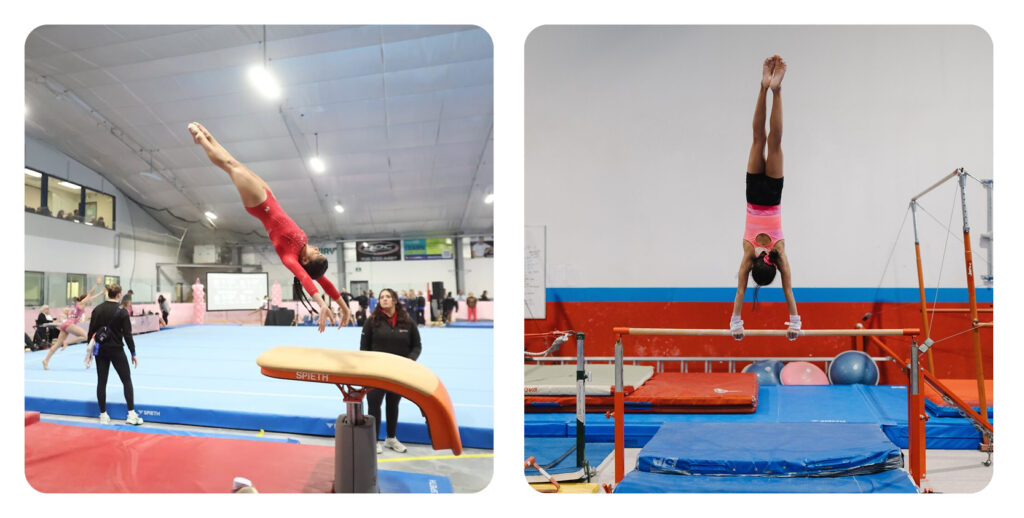
Gymnastics benefits kids in three areas: physically (strength, flexibility, coordination, bone density, posture), mentally (focus, discipline, resilience, body confidence) and socially (teamwork, listening, friendships). Because it trains every fundamental movement pattern, it is widely considered the best foundation sport for children.
Parents typing “benefits of gymnastics for kids” into Google are usually asking one of two questions: Is this a real developmental advantage, or is it hype? and Will it still help my child if they never compete? The short answer to both is yes. Below are 15 benefits, each grounded in research or guidelines from bodies like the American Academy of Pediatrics, CSEP, and Sport for Life, organized by physical, mental, and social impact plus a look at which changes parents notice first.
Physical Benefits (1–6)
The physical benefits of gymnastics are the most visible and best-studied. Because gymnastics loads the body in every direction pushing, pulling, hanging, jumping, landing it develops strength, flexibility, and coordination in kids at rates most single-focus sports can’t match.
Full-Body Strength and Muscular Development
Benefits #1 and #2: total-body strength and relative strength (bodyweight control). Unlike sports that emphasize one plane of motion, gymnastics uses the entire kinetic chain. Research summarized by the American Academy of Pediatrics on youth resistance training confirms that supervised, bodyweight-based training is safe and beneficial for children when programs emphasize technique over load. Kids in recreational gymnastics build the muscular foundation to control their own body weight which pays off in every other sport they try. See our companion piece on cross-training benefits for other sports.
Flexibility, Range of Motion, and Injury Prevention
Benefit #3: flexibility. Gymnastics is unusual in pairing strength work with active range-of-motion training in the same session. Sports medicine research consistently links early flexibility work with reduced overuse injuries later in adolescence. A child who can safely reach end ranges is far less likely to strain a hamstring on the soccer pitch.
Coordination, Balance, and Bone Density
Benefits #4, #5, and #6: coordination, balance, and bone density. This is where gymnastics earns its reputation as gymnastics as a foundation sport. Weight-bearing impact activities are among the most effective ways to build bone mineral density in childhood, a peak-bone-mass window that closes in the late teens. The Canadian 24-Hour Movement Guidelines, published by CSEP, specifically recommend daily bone-strengthening and muscle-strengthening activity for kids aged 5–17. A well-equipped gymnastics facility with beams, bars, spring floors, and vaults hits all three.
Mental and Emotional Benefits (7–11)
The mental benefits of youth sport are often underestimated. Gymnastics, in particular, demands sustained focus for skills that take weeks to master which builds cognitive stamina alongside physical stamina.
Focus, Attention, and Executive Function
Benefits #7 and #8: focus and executive function. Learning a cartwheel isn’t just physical; it requires the child to break down a sequence, hold it in working memory, and self-correct. Research in developmental neuroscience links this kind of complex motor learning to measurable gains in executive function. Parents often report better homework focus within a few months.
Discipline and Resilience Through Repetition
Benefits #9 and #10: discipline and resilience. Every gymnastics skill fails dozens of times before it’s landed. That built-in repetition-and-reset cycle is one of the best life skills through sport a child can absorb. Angela Duckworth’s widely-cited research on grit found that persistence in the face of failure is a stronger predictor of long-term achievement than raw talent. Read more on discipline and resilience through sport.
Body Confidence and Self-Esteem
Benefit #11: body confidence. Gymnastics is one of the strongest confidence building activities for children because progress is visible. A child can see they couldn’t hold a handstand last month and can hold one now. That evidence-based confidence is very different from generalized praise. Explore this deeper in our post on how gymnastics builds confidence.
Social Benefits (12–15)
Social development through gymnastics happens quietly, but consistently. Even in a sport that looks individual, kids spend most of class in shared spaces, waiting turns, and cheering peers.
Listening, Turn-Taking, and Communication
Benefits #12 and #13: listening skills and communication. Every station rotation trains a child to hold instructions in mind, wait, respond, and move on. Coaches often see kids under 6 make dramatic listening gains within a single 12-week session.
Teamwork and Cooperative Learning
Benefit #14: teamwork. Even in recreational classes, kids spot each other, cheer each other’s landings, and problem-solve group warm-ups together. As one parent, Priya S., told us: “My daughter used to hide behind me at birthday parties. After one session at the gym she was inviting kids over to practise cartwheels in our backyard.”
Friendships and Belonging
Benefit #15: friendships and belonging. Youth sport research consistently identifies belonging as a top protective factor for child mental health. Weekly classes with familiar coaches and peers give kids a low-stakes social anchor outside of school, often their first.
What the Research Says About the Benefits of Gymnastics for Kids
The evidence base is strong and growing. Below is a snapshot of what the peer-reviewed and institutional literature consistently shows about the benefits of gymnastics for kids.
Longitudinal Studies on Movement and Child Development
Studies published in journals like Pediatric Exercise Science and Journal of Sports Sciences consistently find that children in structured multi-directional movement programs (like gymnastics) score higher on standardized motor competence assessments than peers in single-sport specialization.
Why Coaches Call Gymnastics a Foundation Sport
Sport for Life’s Long-Term Development framework identifies ages 6–12 as the “golden window” for building physical literacy, the ABCs of agility, balance, coordination, and speed. Gymnastics trains all four in every class, which is why coaches from hockey, soccer, and dance routinely send kids to gymnastics first.
Debunking the Common Myths
The most persistent myth is that gymnastics stunts growth. It ‘s a misreading of self-selection in elite competitive populations. We break the science down in the growth-stunting myth, debunked.
Benefits by Age Group
Not every benefit shows up at every age. The table below summarizes what parents typically see, and where.
| Age Group | Physical Gains | Mental Gains | Social Gains |
| 1–5 years | Balance, coordination, body awareness, bone-loading | Focus, listening, self-regulation | Turn-taking, comfort with peers |
| 6–9 years | Strength, flexibility, motor patterns, core stability | Discipline, resilience, executive function | Teamwork, close friendships |
| 10+ years | Bone density, cross-training base, injury resilience | Grit, body confidence, goal-setting | Leadership, mentorship of younger kids |
For the youngest gymnasts, healthy habits in childhood daily movement, listening in a group setting, comfort with physical risk are built from the very first class. Our early-years programs are designed around exactly that window; read more on early childhood development gains for a deep dive.
For school-age kids, the payoff shifts toward skill and social bonds. Our girls’ recreational gymnastics and boys’ recreational gymnastics programs both target the 6+ window.
Which Benefits Show Up After Just One Season
Twelve weeks is enough. Here’s what parents most commonly notice in the first season.
Weeks 1–4 Body Awareness and Listening
Kids stop bumping into furniture. They start freezing on command. They ask to “practise” at home.
Weeks 5–8 Coordination and Confidence Emerge
By the second month, cartwheels get closer, handstands hold longer, and kids start describing themselves as “strong.” One parent, Marcus T., shared: “By week six, our son was demoing forward rolls for his grandma at Thanksgiving. He’d never volunteered to perform anything before.”
Weeks 9–12 Discipline, Friendships, and First Real Skills
By the end of the first season, kids know their coach and classmates by name, have landed at least one skill they couldn’t do at week one, and most importantly want to sign up again. That’s the loop that turns benefits into long-term outcomes.
Frequently Asked Questions
At what age can toddlers start gymnastics?
Toddlers can start gymnastics in a parent-and-tot setting as early as 10 months. Independent preschool classes begin around age 3. Gymnastics Ontario and Gymnastics Canada both recognize this early window as ideal for building physical literacy and basic movement vocabulary.
Do parents participate in toddler classes?
Yes. In our 10-month–2-year Parent & Tot classes, caregivers are on the floor with their child the entire time. From age 3, kids work independently with coaches while parents watch from the Gym Jungle mezzanine. The transition is gradual and supportive.
How long is a toddler gymnastics class?
Toddler gymnastics classes are short by design. Parent & Tot sessions run 45 minutes, and preschool classes for ages 3–5 typically run 55 minutes. These lengths match toddler attention spans and prevent overstimulation, which keeps kids excited to come back next week.
What if my toddler is too wild or too shy for a class?
Both ends of the spectrum are completely normal. Coaches are trained to redirect high-energy kids with structured movement and gently invite shy toddlers in at their own pace. Most “wild” or “shy” labels disappear within three weeks of consistent attendance.
What should toddlers wear to gymnastics?
Toddlers should wear comfortable, fitted athletic clothing — a bodysuit, leggings, or a t-shirt and shorts. No buttons, zippers, dresses, or jewelry. Bare feet are standard. Long hair should be tied back, and bring a labelled water bottle for station breaks.